
Permissions and questions
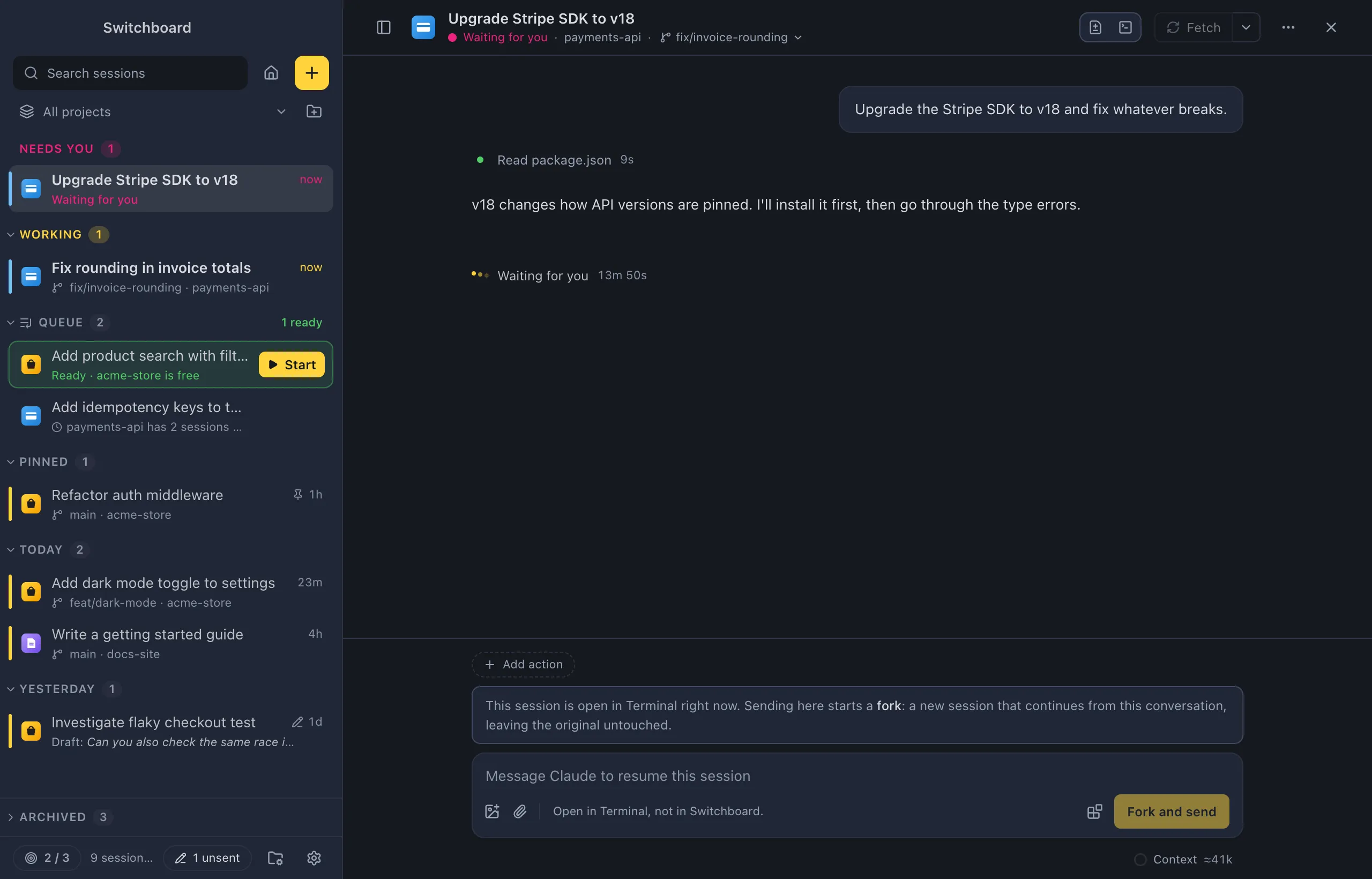
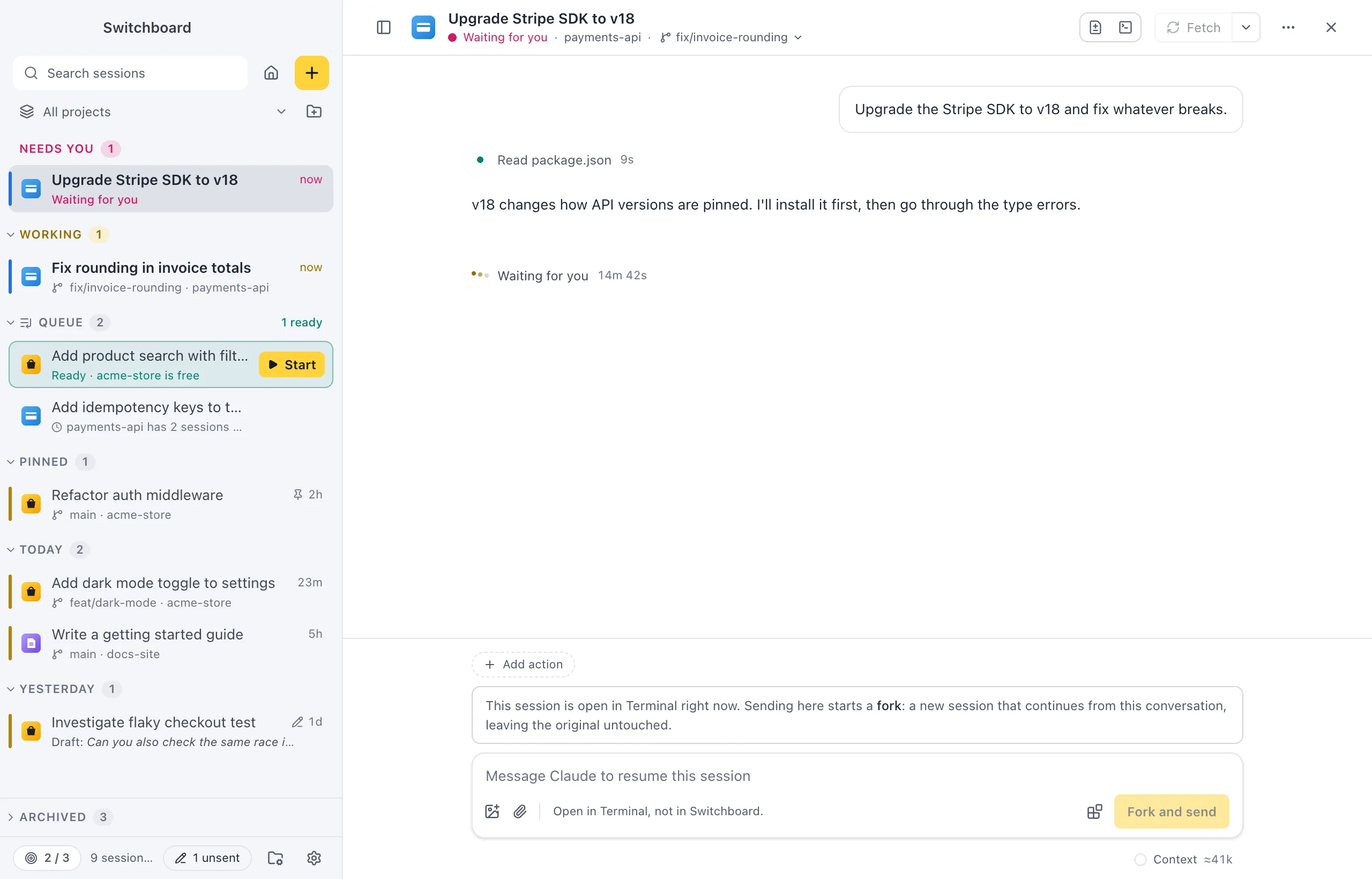
When Claude wants to run a command or edit a file, has a question for you, or has a plan ready, it waits for you. Switchboard shows a card above the message box with everything you need to decide, and marks the session Needs you everywhere until you answer.
Where to find it
Section titled “Where to find it”A session that needs you shows up in several places at once:
- The sidebar puts it in the Needs you group at the top, with a pink rail and a pulsing dot. Home lists it first too.
- A notification and the Dock badgea dot on the taskbar button tell you, also while Switchboard is in the background. In the background, the Dock icon bouncesthe taskbar button also flashes until you switch to Switchboard. The notification says what Claude wants: “Claude wants to use Bash”, “Claude has a question” or “Claude has a plan for you”. Click it to open the session.
- Press Command, Shift, UControl, Shift, U to go to the next session that needs you, or run Go to next session that needs you in the command palette.
- With the session open, Go to the permission or Go to the question in the palette scrolls to the card.
The card itself has a pink frame. After a minute it says how long it has been waiting (“Waiting 2m”). A card from a subagent says “From a subagent”.
Permissions
Section titled “Permissions”The card says what Claude wants to do, such as “Claude wants to run a command”, and shows the command or the file. Show details shows everything Claude sent with the request.
| Button | Key | What it does |
|---|---|---|
| Allow | Command, Return or Control, ReturnControl, Enter or Control, Enter | Allows this once. Claude asks again next time. |
| Always allow … | Allows this and adds a rule, so Claude doesn’t ask again for the same thing, such as “Always allow Bash(npm test:*) in this project”. Shown when Claude Code offers a rule. | |
| Deny | Escape | Says no. |
To say no and tell Claude what to do instead, type in the field under the buttons (“Or tell Claude what to do instead…”) and press ReturnEnter. Claude gets your text with the denial.
Questions
Section titled “Questions”When Claude has a question (“Claude has a question for you”), the card lists the answers it suggests, each with a number.
- Press a number key (1 to 9) to pick an answer, or click it. With several questions, a single-choice answer moves on to the next question.
- ReturnEnter moves on to the next question, and on the last one sends your answers.
- Type your own answer in the field under the choices (“Or type your own answer”).
- Some questions take more than one answer: tick each, and add something else if you want.
- Answer (Command, Return or Control, ReturnControl, Enter or Control, Enter) sends your answers once every question has one.
- Skip (Escape) skips the question.
In Plan mode, Claude reads and plans without making changes. When it’s done, the card shows the plan (“Claude has a plan. Ready to start?”):
| Button | Key | What it does |
|---|---|---|
| Approve and accept edits | Command, Return or Control, ReturnControl, Enter or Control, Enter | Starts, and switches the session to Accept edits, so file edits apply without asking. |
| Approve, ask before edits | Starts, and asks before each file edit. | |
| Keep planning | Escape | Claude goes on planning. Type what to change in the field under the buttons first, and press ReturnEnter to send it. |
Answer from the keyboard
Section titled “Answer from the keyboard”The keys belong to the first card of the session you are looking at. With two sessions side by side, only the active pane’s card answers.
- Command, Return or Control, ReturnControl, Enter or Control, Enter allows, sends your answers, or approves a plan.
- Escape denies, skips, or keeps planning. While a card is waiting, Escape in the message box answers the card instead of stopping Claude.
- 1 to 9 picks an answer to a question.
Some keys are left alone where they would do the wrong thing: number keys typed in the message box are text, Command, ReturnControl, Enter in the “tell Claude what to do instead” field doesn’t allow what you are explaining a no for, and Escape in your own answer doesn’t skip the question. A card that appears while you type doesn’t take your focus, so an ReturnEnter meant for your message never approves something you didn’t read.
Permission modes
Section titled “Permission modes”The permission mode decides how often Claude asks. Change it with the mode chip under the message box, or press Shift, TabShift, Tab in the message box to cycle through Ask before edits, Accept edits and Plan mode. In the command palette, Change permission mode… lists every mode.
| Mode | When Claude asks |
|---|---|
| Ask before edits | Before every edit and command |
| Accept edits | File edits apply; commands still ask |
| Plan mode | Claude reads and plans, and shows you the plan |
| Auto mode | Only when it matters |
See Model, effort and mode for the chips.
Sessions from the terminal
Section titled “Sessions from the terminal”With Show sessions from other apps on in Settings → Sidebar, Claude Code sessions running in your terminal show up in the sidebar too. When one waits for a permission, it moves to Needs you and a notification says “Claude is waiting for you in Terminal”. Answer it in the terminal where it runs: Switchboard doesn’t drive that process.
If you send a message to a session that is open in another app, Switchboard starts a fork instead: a new session that continues from the conversation, leaving the original untouched.
Answer from VS Code
Section titled “Answer from VS Code”With the VS Code companion installed, the prompts of sessions in your VS Code workspace show up as notifications there too, so you don’t have to switch apps:
- A permission offers Allow, the Always allow rule when there is one, Deny… (with an optional note for Claude) and Show in Switchboard.
- A question offers Answer…, with a pick list per question and your own answer as the last choice, and Skip.
- A plan offers Read the plan, which opens it in a preview, then Approve and accept edits, Approve, ask before edits or Keep planning….
Dismissing a notification leaves the prompt waiting in Switchboard. The command Switchboard: Answer Prompts shows the waiting ones again. When you already answered in Switchboard, VS Code says “That was already answered in Switchboard.” The status bar says Switchboard: 1 needs you when a session in the workspace waits for you.
Settings
Section titled “Settings”- Settings → Sidebar: Show sessions from other apps lists terminal sessions and notifies you when one waits.
- Settings → VS Code: the companion that lets you answer from VS Code.
- A project’s Settings tab: the permission mode new sessions start in.